Cat Diabetes Remission: How to Get Your Cat Off Insulin (Diet, Monitoring & What to Expect)
Written by a small animal veterinary specialist with expertise in feline endocrinology and diabetes management.
Here’s something most cat owners don’t hear at the vet’s office: a diabetes diagnosis is not necessarily a life sentence of twice-daily injections. Cat diabetes remission — where blood sugar normalizes and insulin is no longer needed — happens in 50 to 70 percent of newly diagnosed cats, according to the 2026 AAHA Feline Diabetes Management Guidelines. That number is remarkable compared to dogs or humans. But there’s a catch: the window to reach remission is narrow, and what you do in the first few months makes all the difference.
This guide walks you through the exact steps — the right insulin to ask for, what to feed, how to run glucose curves at home, and what the new oral medications mean for cats who hate needles — so you can give your cat the best possible shot at getting off insulin for good.
What Diabetic Remission Actually Means
Cat diabetes remission doesn’t mean your cat is cured. It means the pancreatic beta cells that produce insulin have recovered enough function that your cat’s body can regulate blood sugar on its own — without injections. feline diabetes causes and symptoms
Vets typically declare remission when a cat maintains blood glucose consistently below 150 mg/dL (8.3 mmol/L) for at least four weeks after insulin is tapered and stopped. Some clinicians use a stricter threshold of 130 mg/dL. Either way, confirmed remission means no more daily injections, though monitoring continues indefinitely.
Cats can achieve this because feline diabetes is usually “type 2-like” — caused by insulin resistance and beta cell exhaustion rather than autoimmune destruction of beta cells (as in human type 1). Remove the stress on those cells early enough, and they bounce back. Wait too long, and the damage becomes permanent.
The Remission Window: Diabetic Cat Remission Rates and Why the First 6 Months Matter
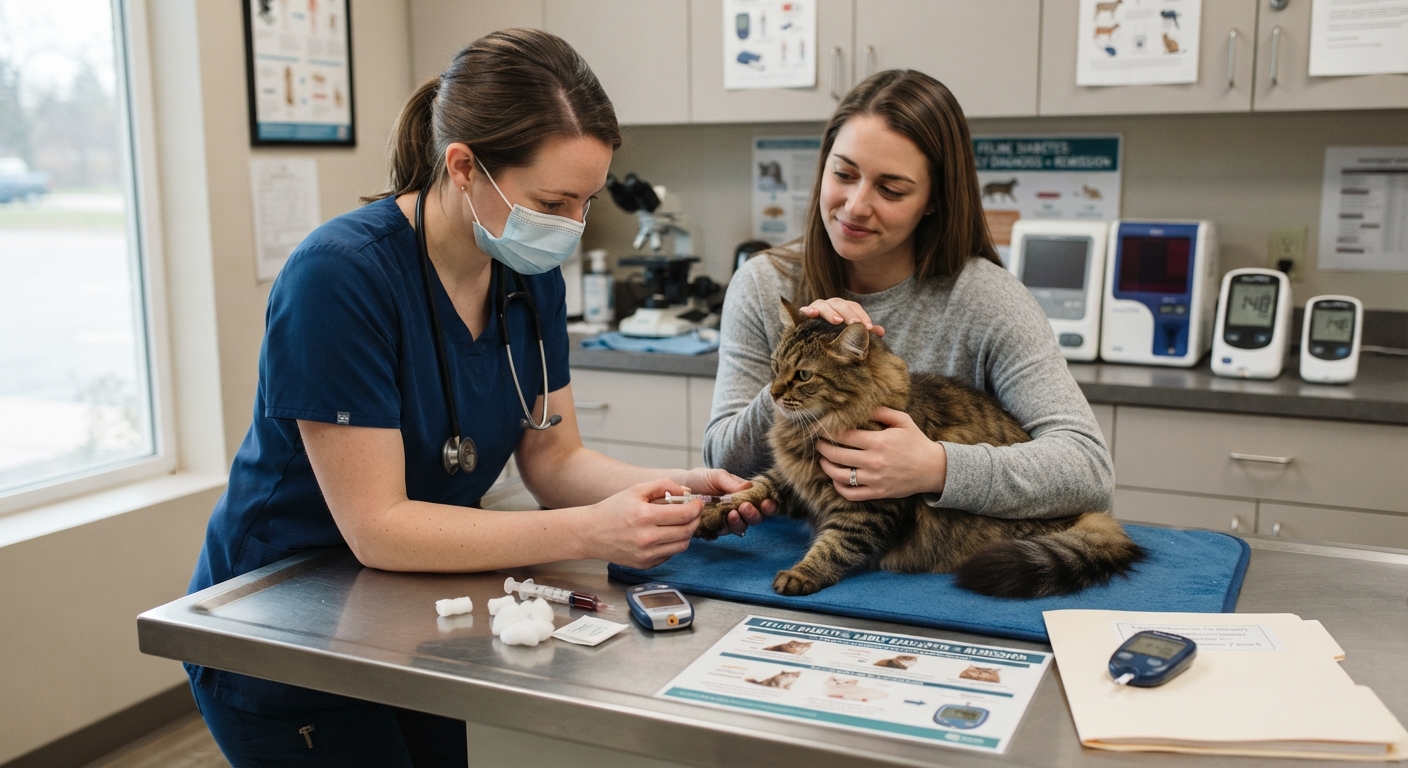
The diabetic cat remission rate drops significantly after six months of uncontrolled diabetes. Prolonged high blood sugar causes glucose toxicity to the pancreatic beta cells — the longer it goes on, the less reversible the damage becomes.
Think of it like a sprint, not a marathon:
- Weeks 1–2: Start the correct insulin and transition to a low-carb diet simultaneously
- Month 1: Establish home glucose monitoring; your vet adjusts insulin dose based on your curves
- Months 2–3: Many remission candidates see glucose begin dropping; some need dose reductions
- Month 4–6: Cats achieving remission typically taper off insulin during this window
If your cat was just diagnosed, the most valuable thing you can do today is start the diet change and ask your vet specifically about insulin options optimized for remission.
Insulin Types Compared: Which Gives the Best Remission Odds
Not all insulin is equal when remission is the goal. The feline diabetes insulin types comparison matters more than most owners realize.
Glargine (Lantus, Basaglar) is the top pick for remission. It’s a long-acting, peakless insulin that keeps blood sugar steadily controlled without sharp drops. Multiple studies put remission rates at 50–90% with glargine plus a low-carb diet — the highest of any insulin type. It requires refrigeration and comes in a human vial, but it works out cheaper than veterinary-specific options.
ProZinc is the only FDA-approved insulin specifically for cats. It performs well, with remission rates around 40–60% in studies. It’s slightly more forgiving to dose for new owners because of its intermediate action profile. Some vets prefer it for cats with unpredictable eating habits.
Vetsulin (PZI pork insulin) is another veterinary option, but it peaks and wanes more than glargine, creating a less stable glucose environment. Remission rates are lower — roughly 20–35% in comparative data. It’s sometimes chosen when cost is the primary driver.
The takeaway: if remission is the goal and your vet hasn’t specifically discussed glargine, ask why. It’s the evidence-backed first choice under the 2026 AAHA guidelines.
The Low-Carb Diet Protocol: Best Diabetic Cat Food Brands and Carb Targets
Diet is not optional in remission — it’s arguably as important as the insulin itself. Cat diabetes diet low carb means targeting under 10% of calories from carbohydrates on a dry-matter basis. For many commercial foods, especially dry kibble, that’s a dramatic shift.
Why Dry Food Is the Enemy
Dry cat food typically runs 25–50% carbohydrates on a dry-matter basis. Every bowl raises blood sugar and forces the pancreas to work harder. Switching to wet food alone — even a non-prescription brand — can reduce insulin requirements by 30–50% in some cats within days.
Brand-by-Brand Carb Comparison
Here are eight widely available wet foods ranked by approximate dry-matter carbohydrate percentage:
| Brand / Product | Approx. DM Carb % | Prescription? |
|---|---|---|
| Fancy Feast Classic Pâté (most flavors) | 2–5% | No |
| Weruva Cats in the Kitchen (most flavors) | 3–6% | No |
| Purina Pro Plan Veterinary Diets DM | 5–8% | Yes |
| Royal Canin Glycobalance | 10–14% | Yes |
| Hill’s m/d (wet) | 7–12% | Yes |
| Tiki Cat (most pâté flavors) | 2–6% | No |
| Friskies Pâté (most flavors) | 5–8% | No |
| Blue Buffalo Wilderness (wet) | 5–9% | No |
A few things stand out here. Fancy Feast Classic Pâté and Tiki Cat are routinely recommended by the feline diabetes community because they’re affordable, widely available, and hit the carb targets without a prescription. Royal Canin Glycobalance — commonly recommended by vets — is actually higher in carbs than several over-the-counter options. It’s not a bad food, but it’s not the best remission food either.
Always verify the specific flavor you’re buying using the manufacturer’s nutrient analysis. Formulas change. how to calculate dry-matter carbohydrates in cat food
Transitioning Off Dry Food
Cats are creatures of habit and can be stubborn about food changes. A cold-turkey switch often leads to food refusal, which is dangerous in diabetics (it can cause hypoglycemia if they miss a meal but still got their insulin).
Transition over 10–14 days: start by mixing 25% wet food with 75% dry, then 50/50, then 75/25, then all wet. If your cat refuses wet food entirely, try warming it slightly, switching to a different texture (some cats prefer chunked over pâté), or trying a low-carb dry food as a temporary bridge — though no dry food is ideal long-term for a diabetic cat.
Home Blood Glucose Monitoring Step-by-Step
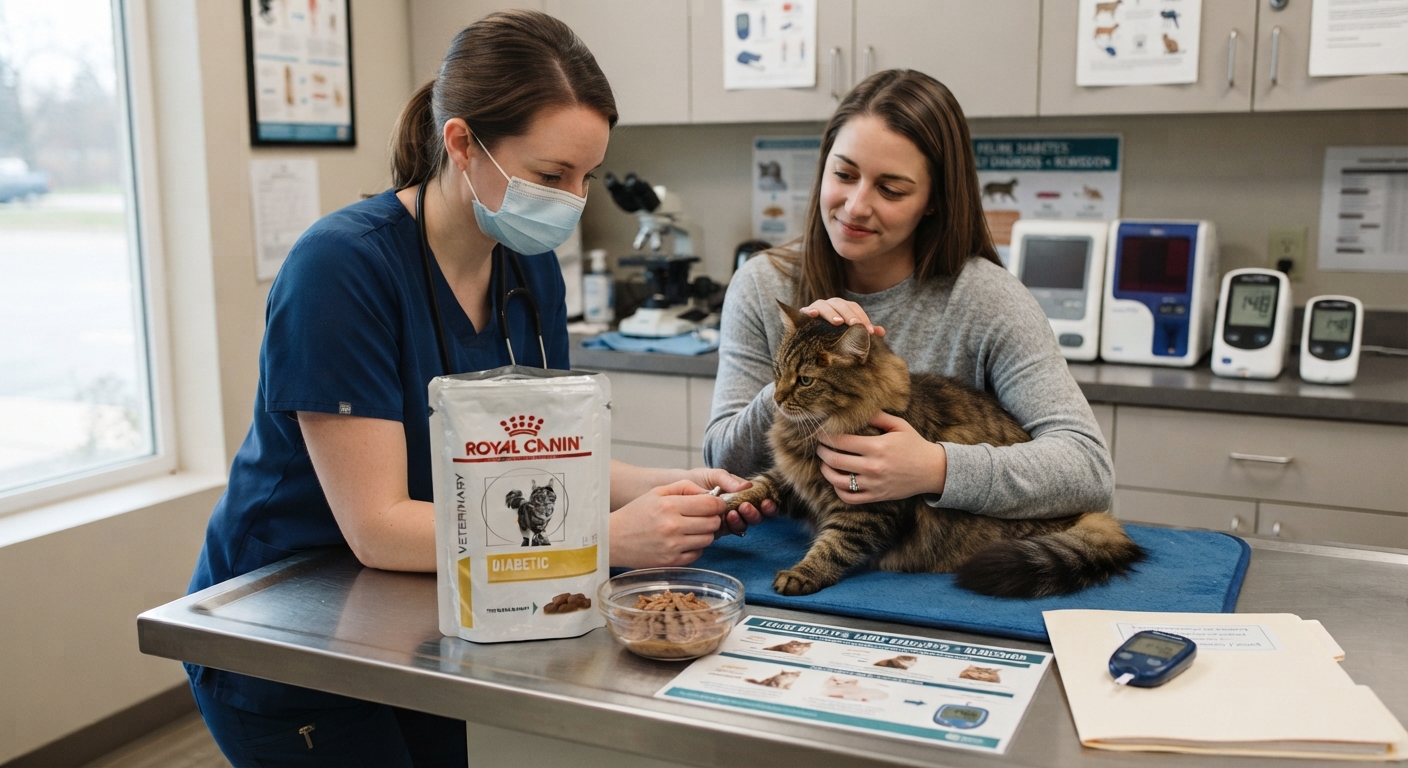
You cannot manage a diabetic cat toward remission without home monitoring. Glucose levels fluctuate throughout the day, and vet-only checks (called spot checks) are too infrequent and too stress-elevated to give a real picture. Home blood glucose monitoring is the skill that separates owners who achieve cat diabetes remission from those who don’t.
AlphaTRAK 2 (Traditional Glucometer)
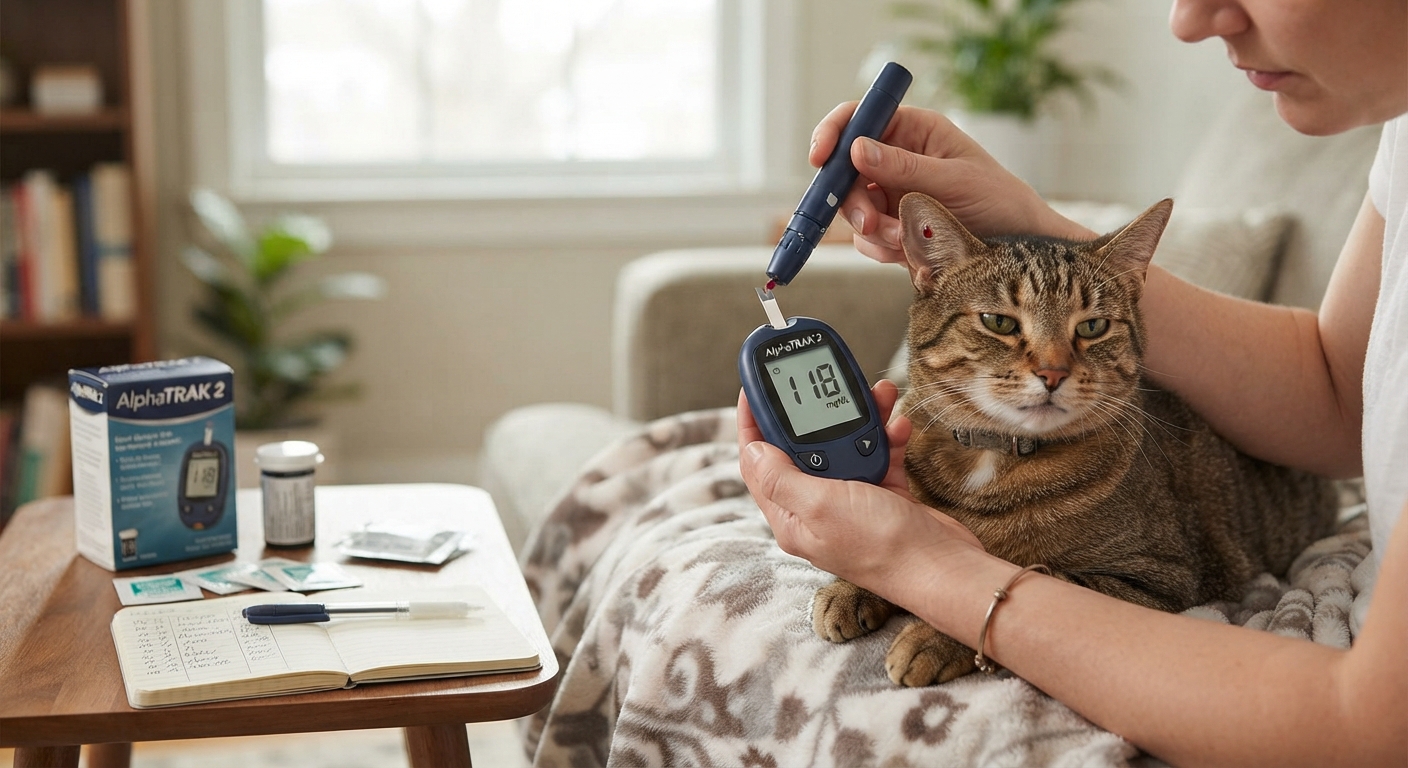
The AlphaTRAK 2 is calibrated specifically for cats and dogs — do not use a human glucometer, as cat blood has different red blood cell concentrations and readings will be inaccurate. The ear prick method is standard: warm the ear flap with your fingers for 30 seconds, prick the marginal ear vein on the outer edge with a lancet, and touch the test strip to the small bead of blood that forms. Most cats tolerate this well once they’re used to the routine.
Starter kit costs roughly $50–$70; test strips run $1–$1.50 each. A glucose curve (8 readings over 12 hours) uses 8 strips and takes a full day but is essential every 1–2 weeks during active management. step-by-step guide to cat blood glucose curves at home
FreeStyle Libre CGM for Cats
The FreeStyle Libre is a continuous glucose monitor (CGM) designed for humans, but it has been adapted for cats by applying a small sensor patch to the scruff of the neck. It reads interstitial glucose every 15 minutes for up to 14 days without individual pricks. The sensor costs around $60–$80 and requires a custom adhesive wrap to stay on a cat.
The CGM approach gives far richer data — you can see overnight trends, meal spikes, and nadir (lowest point) values that you’d never catch with spot testing. The tradeoff is that application requires practice or a vet visit, and the values are interstitial (slightly delayed from blood glucose). Many experienced owners use CGM during active dose adjustment and switch to periodic AlphaTRAK curves for maintenance.
Reading Your Glucose Curve: What the Numbers Mean
A glucose curve plots readings taken every 1–2 hours across the day. What you’re looking for:
- Nadir (lowest reading): Should stay above 80 mg/dL (4.4 mmol/L). Below 60 mg/dL is hypoglycemia — a medical emergency.
- Pre-shot glucose: The reading just before the next insulin dose. If it’s below 200 mg/dL, many vets recommend skipping or halving the dose.
- Peak glucose: Should ideally stay below 300 mg/dL (16.7 mmol/L) throughout the curve.
A cat trending toward remission will show curves where the nadir drops consistently and the pre-shot numbers fall below 200 without insulin — a signal to begin tapering. When your vet sees two or three consecutive curves below 150 mg/dL throughout the entire curve, they’ll typically recommend stopping insulin and monitoring daily.
Red flags that need same-day vet contact:
- Any reading below 60 mg/dL
- Cat is lethargic, wobbly, or won’t eat
- Glucose above 500 mg/dL for more than one reading in a curve
- Cat in remission whose glucose climbs back above 300 mg/dL (possible relapse)
New in 2026: Oral SGLT2 Inhibitors for Cats
The 2026 AAHA guideline update formally addresses a new class of medications: SGLT2 inhibitors (SGLT2i). Originally developed for type 2 diabetes in humans, drugs like empagliflozin (Jardiance) and dapagliflozin (Forxiga) work by causing the kidneys to excrete excess glucose in urine rather than returning it to the bloodstream.
The veterinary-specific formulation has been conditionally approved in several markets for cats who cannot tolerate injections or whose owners are unable to administer them. Early data shows remission rates comparable to glargine in newly diagnosed cats when combined with a low-carb diet.
This is worth knowing for two reasons. First, if needle anxiety — yours or your cat’s — is a barrier to treatment, an oral option now exists. Second, if your vet hasn’t mentioned it, they may not be up to date on the 2026 guidelines. These drugs are not appropriate for every cat (they’re contraindicated in cats with urinary tract infections or kidney disease), but for the right patient they’re a genuine advance.
Cat Diabetes Treatment Cost: What to Budget
Cat diabetes treatment cost is real, and it’s worth going in with accurate expectations rather than being blindsided.
Annual cost breakdown (approximate):
| Expense | Low estimate | High estimate |
|---|---|---|
| Insulin (glargine vial, ~4/year) | $120 | $300 |
| Syringes (1,000/year) | $30 | $60 |
| AlphaTRAK test strips | $200 | $400 |
| Vet visits (4–8/year while managing) | $400 | $1,200 |
| Prescription food (if used) | $400 | $800 |
| CGM sensors (optional) | $0 | $600 |
| Total | ~$1,150 | ~$3,360 |
Costs drop substantially once remission is achieved — vet visits become less frequent, no insulin to buy, and monitoring scales back to monthly spot checks. That’s another argument for pursuing remission aggressively early.
Pet insurance is worth examining. Most policies with illness coverage will cover insulin, test strips, and vet visits for a diagnosed diabetic cat, but pre-existing conditions are typically excluded. If your cat was diagnosed before you got insurance, you’re likely out of luck. If you’re shopping for insurance for a healthy cat, adding a policy before any diagnosis is worthwhile — look for plans from Trupanion, Healthy Paws, or Figo that include chronic illness with no annual caps, since diabetes management is ongoing. best pet insurance for cats with chronic illness
Life After Remission: Preventing Relapse
Remission is not a finish line you cross and forget. Roughly 30–40% of cats in remission will relapse — often within 1–2 years — especially if the low-carb diet lapses or weight climbs back up.
After cat diabetes remission is confirmed:
- Continue the low-carb wet food diet permanently. This is non-negotiable.
- Check glucose monthly with a quick at-home spot check (one reading, no full curve needed).
- Weigh your cat every 2–3 months. Obesity is the top remission risk factor.
- Keep a glucometer and insulin on hand. If relapse happens, you want to restart treatment the same day, not after a 3-day wait for a vet appointment.
- Schedule a vet recheck every 6 months even when things look good.
A cat who achieves remission and stays in remission with good management can live a fully normal life. That outcome is realistic — but only with the owner doing the work.
Frequently Asked Questions
What is the diabetic cat remission rate, and does every cat have a chance?
The diabetic cat remission rate ranges from 50 to 70 percent for newly diagnosed cats treated promptly with the right insulin (usually glargine) and a strict low-carb diet. Cats diagnosed later, those with long-standing uncontrolled diabetes, or those with concurrent illnesses have lower odds. Early, aggressive treatment gives your cat the best chance.
Which cat food brands are best for a low-carb diabetic cat diet?
The most accessible low-carb diabetic cat food brands are Fancy Feast Classic Pâté (most flavors), Tiki Cat pâté, and Weruva Cats in the Kitchen — all under 6% carbohydrates on a dry-matter basis and available without a prescription. Prescription foods like Purina Pro Plan DM and Hill’s m/d are legitimate options but aren’t necessarily lower in carbs than these grocery-store picks.
How do I do home blood glucose monitoring for my cat?
The standard method is the marginal ear vein prick using an AlphaTRAK 2 glucometer (calibrated for cats). Warm the ear, prick the outer edge of the ear flap with a lancet, and touch the test strip to the blood droplet. It takes 30–60 seconds once you’re practiced. The FreeStyle Libre CGM is a continuous alternative that patches to the scruff — it provides richer data but costs more per week of monitoring.
What are SGLT2 inhibitors for cats, and are they available?
SGLT2 inhibitors like empagliflozin (Jardiance) and dapagliflozin (Forxiga) are oral diabetes medications that lower blood sugar by promoting glucose excretion in urine. The 2026 AAHA feline diabetes guidelines formally recognize them as an alternative for cats who cannot receive injections. Availability varies by region and requires a veterinary prescription. They’re not appropriate for cats with kidney disease or frequent UTIs.
How much does treating feline diabetes cost per year?
Cat diabetes treatment costs roughly $1,100 to $3,400 per year depending on insulin type, monitoring approach, and vet visit frequency. The largest variables are prescription food, CGM sensor use, and vet checkup frequency during active management. Costs drop significantly after remission, since insulin and high-frequency monitoring are no longer needed.